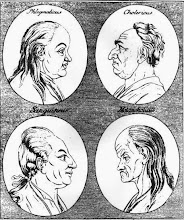
III The Gay Science Nietzsche
One thing is needful.— To "give style" to one's character—a great and rare art! It is practiced by those who survey all the strengths and weaknesses of their nature and then fit them into an artistic plan until every one of them appears as art and reason and even weaknesses delight the eye. Here a large mass of second nature has been added, there a piece of original nature has been removed:—both times through long practice and daily work at it. Here the ugly that could not be removed is concealed, there it has been reinterpreted and made sublime. Much that is vague and resisted shaping has been saved and exploited for distant views:—it is meant to beckon toward the far and immeasurable. In the end, when the work is finished, it becomes evident how the constraint of a single taste governed and formed everything large and small: whether this taste was good or bad is less important than one might suppose,—if only it was a single taste!— It will be the strong and domineering natures that enjoy their finest gaiety in such constraint and perfection under a law of their own; the passion of their tremendous will relents in the face of all stylized nature, of all conquered and serving nature; even when they have to build palaces and design gardens they demur at giving nature freedom.— Conversely, it is the weak characters without power over themselves that hate the constraint of style: they feel that if this bitter and evil constraint were imposed upon them they would be demeaned:— they become slaves as soon as they serve; they hate to serve. Such spirits—and they may be of the first rank—are always out to shape and interpret their environment as free nature—wild, arbitrary, fantastic, disorderly, and surprising. And they are well advised because it is only in this way that they can give pleasure to themselves! For one thing is needful: that a human being should attain satisfaction with himself—whether it be by means of this or that poetry and art: only then is a human being at all tolerable to behold! Whoever is dissatisfied with himself is continually ready for revenge: and we others will be his victims, if only by having to endure his ugly sight. For the sight of what is ugly makes one bad and gloomy.
Sunday, February 18, 2007
spirit
II. A Human Life (Stirner cont.)
From the moment when it catches sight of the light of the world a child seeks to find out itself and get hold of itself out of its confusion, in which it, with everything else, is tossed about in motley mixture.
But everything that comes in contact with the child defends itself, in turn, against his attacks and asserts its own persistence.
Accordingly, because each thing cares for itself and at the same time comes into constant collision with other things, the combat of self-assertion is unavoidable.
Victory or defeat - between the two alternatives the fate of the combat wavers. The victor becomes the master, the vanquished one the subject: the former exercises supremacy and "rights of supremacy," the latter fulfils in awe and deference the "duties of a subject."
But both remain enemies, and always lie in wait: they watch for each other's weaknesses - children for those of their parents and parents for those of their children (their fear, for example); either the stick conquers the man, or the man conquers the stick.
In childhood liberation takes the direction of trying to get to the bottom of things, to get at what is "behind" things; therefore we spy out the weak points of everybody, for which, it is well known, children have a sure instinct; therefore we like to smash things, like to rummage through hidden corners, pry after what is covered up or out of the way, and try what we can do with everything. When we once get at what is behind things, we know we are safe; when we have got at the fact that the rod is too weak against our will, then we no longer fear it, "have outgrown it."
Behind the rod, mightier than it, stands our - will, our obstinate courage. By degrees we get at what is behind everything that was mysterious and uncanny to us, the mysteriously-dreaded might of the rod, the father's stern look, etc., and behind all of it we find...our imperturbability, intrepidity,... our invincibility. Before that which formerly inspired in us fear and deference we no longer retreat shyly, but take courage. Behind everything we find our courage, our superiority; behind the sharp command of parents and authorities stands, after all, our courageous choice or our outwitting shrewdness. And the more we feel ourselves, the smaller appears that which before seemed invincible. And what is our trickery, shrewdness, courage, will? What else but - spirit !
Through a considerable time we are spared a fight that is so exhausting later - the fight against reason. The fairest part of childhood passes without the necessity of coming to blows with reason. We care nothing at all about it, do not meddle with it, admit no reason. We are not to be persuaded to anything by conviction, and are deaf to good arguments and principles; on the other hand, coaxing, punishment, and the like are hard for us to resist. This life-and-death combat with reason enters later, and begins a new phase; in childhood we scamper about without racking our brains much.
Spirit is the name of the first self-discovery, the first desecration of the divine; that is, of the uncanny, the spooks, the "powers above." Our fresh feeling of youth, this feeling of self, now defers to nothing; the world is discredited, for we are above it, we are spirit. Now for the first time we see that hitherto we have not looked at the world intelligently at all, but only stared at it.
We exercise the beginnings of our strength on natural powers. We defer to parents as a natural power; later we say: Father and mother are to be forsaken, all natural power is to be counted as corrupt. They are vanquished. For the rational, the "intellectual" man, there is no family as a natural power; a renunciation of parents, brothers, etc., makes its appearance...And not only parents, but men in general, are conquered by the young man; they are no hindrance to him, and are no longer regarded; for now he says: One must obey God rather than men. From this high stand-point everything "earthly" recedes into contemptible remoteness; for the stand-point is - the heavenly.
The attitude is now altogether reversed; the youth takes up an intellectual position, while the boy, who did not yet feel himself as spirit, grew up on mindless learning. The former does not try to get hold of things (for instance, to get into his head the data of history), but of the thoughts that lie hidden in things, and so, therefore, of the [feeling] of history. On the other hand, the boy understands connections no doubt, but not ideas, the mind; therefore he strings together whatever can be learned, without proceeding a priori and theoretically, without looking for ideas.
As in childhood one had to overcome the resistance of the laws of the world, so now in everything that he proposes he is met by an objection of the spirit, of reason, of his own conscience. "That is unreasonable, unchristian, unpatriotic," and the like, cries conscience to us, and - frightens us away from it. Not... the wrath of God,... not the father's rod of punishment, do we fear, but -conscience.
We "run after our thoughts" now, and follow their commands just as before we followed parental, human ones. Our course of action is determined by our thoughts (ideas, conceptions, faith ) as it is in childhood by the commands of our parents.
For all that, we were already thinking when we were children, only our thoughts were not fleshless, abstract, absolute, that is, NOTHING BUT THOUGHTS, a heaven in themselves, a pure world of thought, logical thoughts.
On the contrary, they had been only thoughts that we had about a thing; we thought of the thing so or so. Thus we may have thought "God made the world that we see there," but we did not think of the Nature of God"; we may have thought "that is the truth about the matter," but we do not think of Truth itself, nor unite into one sentence "God is Truth." The nature of God and Truth we did not touch.
To bring to light the pure thought, or to be of its party, is the delight of youth; and all the shapes of light in the world of thought, like truth, freedom, humanity, Man, illumine and inspire the youthful soul.
But, when the spirit is recognized as the essential thing, it still makes a difference whether the spirit is poor or rich, and therefore one seeks to become rich in spirit; the spirit wants to spread out so as to found its empire - an empire that is not of this world, the world just conquered. Thus, then, it longs to become all in all to itself; for, although I am spirit, I am not yet perfected spirit, and must first seek the complete spirit. But with that I, who had just now found myself as spirit, lose myself again at once, bowing before the complete spirit as one not my own but heavenly, and feeling my emptiness. It is not my or your spirit, but just - an ideal,... it is "God." "God is spirit." And this... "Father in heaven gives it to those that pray to him."
The man is distinguished from the youth by the fact that he takes the world as it is, instead of everywhere fancying it amiss and wanting to improve it, model it after his ideal; in him the view that one must deal with the world according to his interest, not according to his ideals, becomes confirmed.
So long as one knows himself only as spirit, and feels that all the value of his existence consists in being spirit (it becomes easy for the youth to give his life, the "bodily life," for a nothing, for the silliest point of honour), so long it is only thoughts that one has, ideas that he hopes to be able to realize some day when he has found a sphere of action; thus one has meanwhile only ideals, unexecuted ideas or thoughts.
Not till one has fallen in love with his corporeal self, and takes a pleasure in himself as a living flesh-and-blood person - but it is in mature years, in the man, that we find it so - not till then has one a personal or egoistic interest, an interest not only of our spirit, for instance, but of total satisfaction, satisfaction of the whole man, a selfish interest. Just compare a man with a youth, and see if he will not appear to you harder, less magnanimous, more selfish. Is he therefore worse? No, you say; he has only become more definite, or, as you also call it, more "practical." But the main point is this, that he makes himself more the centre than does the youth, who is infatuated about other things, for example, God, fatherland, [reputation] and so on.
Therefore the man shows a second self-discovery. The youth found himself as spirit and lost himself again in the general spirit, the complete, holy spirit, Man, mankind - in short, all ideals; the man finds himself as embodied spirit.
Boys had only unintellectual interests (those interests devoid of thoughts and ideas), youths only intellectual ones; the man has bodily, personal, egoistic interests.
If the child has not an object that it can occupy itself with, it feels boredom; for it does not yet know how to occupy itself with itself. The youth, on the contrary, throws the object aside, for thoughts of the object; he occupies himself with his thoughts, his dreams, occupies himself intellectually, or "his spirit is occupied."
As I find myself behind things, and that as mind, so I must later find myself also behind thoughts - to wit, as their creator and owner. In the time of spirits thoughts grew till they overtopped my head, whose offspring they yet were; they hovered about me and convulsed me like fever-phantasies - an awful power. The thoughts had become corporeal on their own account, were ghosts, such as God, Emperor, Pope, Fatherland, etc. If I destroy their corporeality, then I take them back into mine, and say: "I alone am corporeal." And now I take the world as what it is to me, as mine, as my property; I refer all to myself.
The child was realistic, taken up with the things of this world, till little by little he succeeded in getting at what was behind these very things; the youth was idealistic, inspired by thoughts, till he worked his way up to where he became the man, the egoistic man, who deals with things and thoughts according to his heart's pleasure, and sets his personal interest above everything.
From the moment when it catches sight of the light of the world a child seeks to find out itself and get hold of itself out of its confusion, in which it, with everything else, is tossed about in motley mixture.
But everything that comes in contact with the child defends itself, in turn, against his attacks and asserts its own persistence.
Accordingly, because each thing cares for itself and at the same time comes into constant collision with other things, the combat of self-assertion is unavoidable.
Victory or defeat - between the two alternatives the fate of the combat wavers. The victor becomes the master, the vanquished one the subject: the former exercises supremacy and "rights of supremacy," the latter fulfils in awe and deference the "duties of a subject."
But both remain enemies, and always lie in wait: they watch for each other's weaknesses - children for those of their parents and parents for those of their children (their fear, for example); either the stick conquers the man, or the man conquers the stick.
In childhood liberation takes the direction of trying to get to the bottom of things, to get at what is "behind" things; therefore we spy out the weak points of everybody, for which, it is well known, children have a sure instinct; therefore we like to smash things, like to rummage through hidden corners, pry after what is covered up or out of the way, and try what we can do with everything. When we once get at what is behind things, we know we are safe; when we have got at the fact that the rod is too weak against our will, then we no longer fear it, "have outgrown it."
Behind the rod, mightier than it, stands our - will, our obstinate courage. By degrees we get at what is behind everything that was mysterious and uncanny to us, the mysteriously-dreaded might of the rod, the father's stern look, etc., and behind all of it we find...our imperturbability, intrepidity,... our invincibility. Before that which formerly inspired in us fear and deference we no longer retreat shyly, but take courage. Behind everything we find our courage, our superiority; behind the sharp command of parents and authorities stands, after all, our courageous choice or our outwitting shrewdness. And the more we feel ourselves, the smaller appears that which before seemed invincible. And what is our trickery, shrewdness, courage, will? What else but - spirit !
Through a considerable time we are spared a fight that is so exhausting later - the fight against reason. The fairest part of childhood passes without the necessity of coming to blows with reason. We care nothing at all about it, do not meddle with it, admit no reason. We are not to be persuaded to anything by conviction, and are deaf to good arguments and principles; on the other hand, coaxing, punishment, and the like are hard for us to resist. This life-and-death combat with reason enters later, and begins a new phase; in childhood we scamper about without racking our brains much.
Spirit is the name of the first self-discovery, the first desecration of the divine; that is, of the uncanny, the spooks, the "powers above." Our fresh feeling of youth, this feeling of self, now defers to nothing; the world is discredited, for we are above it, we are spirit. Now for the first time we see that hitherto we have not looked at the world intelligently at all, but only stared at it.
We exercise the beginnings of our strength on natural powers. We defer to parents as a natural power; later we say: Father and mother are to be forsaken, all natural power is to be counted as corrupt. They are vanquished. For the rational, the "intellectual" man, there is no family as a natural power; a renunciation of parents, brothers, etc., makes its appearance...And not only parents, but men in general, are conquered by the young man; they are no hindrance to him, and are no longer regarded; for now he says: One must obey God rather than men. From this high stand-point everything "earthly" recedes into contemptible remoteness; for the stand-point is - the heavenly.
The attitude is now altogether reversed; the youth takes up an intellectual position, while the boy, who did not yet feel himself as spirit, grew up on mindless learning. The former does not try to get hold of things (for instance, to get into his head the data of history), but of the thoughts that lie hidden in things, and so, therefore, of the [feeling] of history. On the other hand, the boy understands connections no doubt, but not ideas, the mind; therefore he strings together whatever can be learned, without proceeding a priori and theoretically, without looking for ideas.
As in childhood one had to overcome the resistance of the laws of the world, so now in everything that he proposes he is met by an objection of the spirit, of reason, of his own conscience. "That is unreasonable, unchristian, unpatriotic," and the like, cries conscience to us, and - frightens us away from it. Not... the wrath of God,... not the father's rod of punishment, do we fear, but -conscience.
We "run after our thoughts" now, and follow their commands just as before we followed parental, human ones. Our course of action is determined by our thoughts (ideas, conceptions, faith ) as it is in childhood by the commands of our parents.
For all that, we were already thinking when we were children, only our thoughts were not fleshless, abstract, absolute, that is, NOTHING BUT THOUGHTS, a heaven in themselves, a pure world of thought, logical thoughts.
On the contrary, they had been only thoughts that we had about a thing; we thought of the thing so or so. Thus we may have thought "God made the world that we see there," but we did not think of the Nature of God"; we may have thought "that is the truth about the matter," but we do not think of Truth itself, nor unite into one sentence "God is Truth." The nature of God and Truth we did not touch.
To bring to light the pure thought, or to be of its party, is the delight of youth; and all the shapes of light in the world of thought, like truth, freedom, humanity, Man, illumine and inspire the youthful soul.
But, when the spirit is recognized as the essential thing, it still makes a difference whether the spirit is poor or rich, and therefore one seeks to become rich in spirit; the spirit wants to spread out so as to found its empire - an empire that is not of this world, the world just conquered. Thus, then, it longs to become all in all to itself; for, although I am spirit, I am not yet perfected spirit, and must first seek the complete spirit. But with that I, who had just now found myself as spirit, lose myself again at once, bowing before the complete spirit as one not my own but heavenly, and feeling my emptiness. It is not my or your spirit, but just - an ideal,... it is "God." "God is spirit." And this... "Father in heaven gives it to those that pray to him."
The man is distinguished from the youth by the fact that he takes the world as it is, instead of everywhere fancying it amiss and wanting to improve it, model it after his ideal; in him the view that one must deal with the world according to his interest, not according to his ideals, becomes confirmed.
So long as one knows himself only as spirit, and feels that all the value of his existence consists in being spirit (it becomes easy for the youth to give his life, the "bodily life," for a nothing, for the silliest point of honour), so long it is only thoughts that one has, ideas that he hopes to be able to realize some day when he has found a sphere of action; thus one has meanwhile only ideals, unexecuted ideas or thoughts.
Not till one has fallen in love with his corporeal self, and takes a pleasure in himself as a living flesh-and-blood person - but it is in mature years, in the man, that we find it so - not till then has one a personal or egoistic interest, an interest not only of our spirit, for instance, but of total satisfaction, satisfaction of the whole man, a selfish interest. Just compare a man with a youth, and see if he will not appear to you harder, less magnanimous, more selfish. Is he therefore worse? No, you say; he has only become more definite, or, as you also call it, more "practical." But the main point is this, that he makes himself more the centre than does the youth, who is infatuated about other things, for example, God, fatherland, [reputation] and so on.
Therefore the man shows a second self-discovery. The youth found himself as spirit and lost himself again in the general spirit, the complete, holy spirit, Man, mankind - in short, all ideals; the man finds himself as embodied spirit.
Boys had only unintellectual interests (those interests devoid of thoughts and ideas), youths only intellectual ones; the man has bodily, personal, egoistic interests.
If the child has not an object that it can occupy itself with, it feels boredom; for it does not yet know how to occupy itself with itself. The youth, on the contrary, throws the object aside, for thoughts of the object; he occupies himself with his thoughts, his dreams, occupies himself intellectually, or "his spirit is occupied."
As I find myself behind things, and that as mind, so I must later find myself also behind thoughts - to wit, as their creator and owner. In the time of spirits thoughts grew till they overtopped my head, whose offspring they yet were; they hovered about me and convulsed me like fever-phantasies - an awful power. The thoughts had become corporeal on their own account, were ghosts, such as God, Emperor, Pope, Fatherland, etc. If I destroy their corporeality, then I take them back into mine, and say: "I alone am corporeal." And now I take the world as what it is to me, as mine, as my property; I refer all to myself.
The child was realistic, taken up with the things of this world, till little by little he succeeded in getting at what was behind these very things; the youth was idealistic, inspired by thoughts, till he worked his way up to where he became the man, the egoistic man, who deals with things and thoughts according to his heart's pleasure, and sets his personal interest above everything.

spirit
I. All Things Are Nothing To ME (Max Stirner)
What is not supposed to be my concern!... God's cause, the cause of mankind, of truth, of freedom, of humanity, of justice; further, the cause of my people, my prince, my fatherland; finally, even the cause of Mind, and a thousand other causes. Only my cause is never to be my concern. ''Shame on the egoist who thinks only of himself!"
Let us look and see, then, how they manage their concerns - they for whose cause we are to labour, devote ourselves, and grow enthusiastic.
You have much profound information to give about God... Now, what is his cause? Has he, as is demanded of us, taken up an alien cause, the cause of truth or love, his own? You are shocked by this misunderstanding, and you instruct us that God's cause is indeed the cause of truth and love, but that this cause cannot be called alien to him, because God is himself truth and love; you are shocked by the assumption that God could be like us poor worms in furthering an alien cause as his own... - Now it is clear, God cares only for what is his, busies himself only with himself, thinks only of himself, and has only himself before his eyes; woe to all that is not well pleasing to him. He serves no higher person, and satisfies only himself. His cause is - a purely egoistic cause.
How is it with mankind, whose cause we are to make our own? Is its cause that of another, and does mankind serve a higher cause? No, mankind looks only at itself, mankind will promote the interests of mankind only, mankind is its own cause. That it may develop, it causes nations and individuals to wear themselves out in its service, and, when they have accomplished what mankind needs, it throws them on the dung-heap of history in gratitude. Is not mankind's cause - a purely egoistic cause?
I have no need to take up each thing that wants to throw its cause on us and show that it is occupied only with itself, not with us, only with its good, not with ours. Look at the rest for yourselves. Do truth, freedom, humanity, justice, desire anything else than that you grow enthusiastic and serve them?
They all have an admirable time of it when they receive zealous homage. Just observe the nation that is defended by devoted patriots. The patriots fall in bloody battle or in the fight with hunger and want; what does the nation care for that? By the manure of their corpses the nation comes to "its bloom"! The individuals have died "for the great cause of the nation," and the nation sends some words of thanks after them and - has the profit of it. I call that a paying kind of egoism.
God and mankind have concerned themselves for nothing, for nothing but themselves. Let me then likewise concern myself for myself, who am equally with God the nothing of all others, who am my all, who am the only one.
Away, then, with every concern that is not altogether my concern! You think at least the "good cause" must be my concern? What's good, what's bad? Why, I myself am my concern, and I am neither good nor bad. Neither has meaning for me. The divine is God's concern; the human, man's. My concern is neither the divine nor the human, not the true, good, just, free, etc., but solely what is mine, and it is not a general one, but is - unique, as I am unique. Nothing is more to me than myself!
What is not supposed to be my concern!... God's cause, the cause of mankind, of truth, of freedom, of humanity, of justice; further, the cause of my people, my prince, my fatherland; finally, even the cause of Mind, and a thousand other causes. Only my cause is never to be my concern. ''Shame on the egoist who thinks only of himself!"
Let us look and see, then, how they manage their concerns - they for whose cause we are to labour, devote ourselves, and grow enthusiastic.
You have much profound information to give about God... Now, what is his cause? Has he, as is demanded of us, taken up an alien cause, the cause of truth or love, his own? You are shocked by this misunderstanding, and you instruct us that God's cause is indeed the cause of truth and love, but that this cause cannot be called alien to him, because God is himself truth and love; you are shocked by the assumption that God could be like us poor worms in furthering an alien cause as his own... - Now it is clear, God cares only for what is his, busies himself only with himself, thinks only of himself, and has only himself before his eyes; woe to all that is not well pleasing to him. He serves no higher person, and satisfies only himself. His cause is - a purely egoistic cause.
How is it with mankind, whose cause we are to make our own? Is its cause that of another, and does mankind serve a higher cause? No, mankind looks only at itself, mankind will promote the interests of mankind only, mankind is its own cause. That it may develop, it causes nations and individuals to wear themselves out in its service, and, when they have accomplished what mankind needs, it throws them on the dung-heap of history in gratitude. Is not mankind's cause - a purely egoistic cause?
I have no need to take up each thing that wants to throw its cause on us and show that it is occupied only with itself, not with us, only with its good, not with ours. Look at the rest for yourselves. Do truth, freedom, humanity, justice, desire anything else than that you grow enthusiastic and serve them?
They all have an admirable time of it when they receive zealous homage. Just observe the nation that is defended by devoted patriots. The patriots fall in bloody battle or in the fight with hunger and want; what does the nation care for that? By the manure of their corpses the nation comes to "its bloom"! The individuals have died "for the great cause of the nation," and the nation sends some words of thanks after them and - has the profit of it. I call that a paying kind of egoism.
God and mankind have concerned themselves for nothing, for nothing but themselves. Let me then likewise concern myself for myself, who am equally with God the nothing of all others, who am my all, who am the only one.
Away, then, with every concern that is not altogether my concern! You think at least the "good cause" must be my concern? What's good, what's bad? Why, I myself am my concern, and I am neither good nor bad. Neither has meaning for me. The divine is God's concern; the human, man's. My concern is neither the divine nor the human, not the true, good, just, free, etc., but solely what is mine, and it is not a general one, but is - unique, as I am unique. Nothing is more to me than myself!
Subscribe to:
Comments (Atom)